Microhydrodynamics & Fluctuations 2025/2026
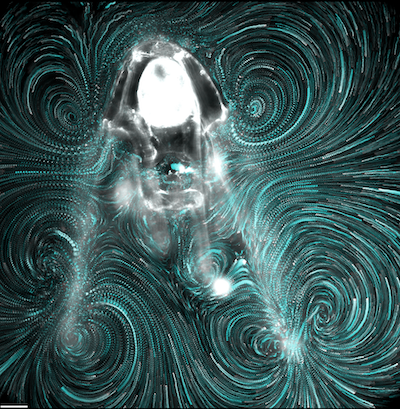
![[Shrestha et al., U. Miami]](https://assets.gfm.aps.org/6504b6ac199e4c16c66a94b3/poster/original/GFM_SeaUrchin_Larva.png)
Jeffrey Everts & Maciej Lisicki
Lectures: Tuesdays 9:15-11:00
Tutorials: Thursdays 12:15-14:00
Course materials
Lectures[Lecture 1 slides]
Tutorials
[Tutorial 1 problems]
[Tutorial 2 problems]
[Tutorial 3 problems]
[Tutorial 4 problems]
[Tutorial 5 problems]
[True vs. pseudo (scalars, vectors, tensors) – note]
Course Outline
- Introduction. Microscale flows in soft matter, biophysics, and technology.
-
Stokes flows
- Properties of Stokes equations (properties, general theorems, Lorentz reciprocal theorem)
- Green's functions and fundamental solutions
- Integral representations of Stokes flows
- Friction and mobility – application to spherical particles
- Multipole expansion of Stokes equations
- Faxén laws
- Hydrodynamic interactions
- Unsteady Stokes flows
- Swimming in microscale
-
Diffusion
- Fluctuation-dissipation theorem
- Self-diffusion vs. collective diffusion
- Short- and long-time diffusion coefficients
- Influence of hydrodynamic interactions
- Effective viscosity (Einstein formula)
- Particle transport in external fields. Phoretic flows (electrophoresis, diffusiophoresis, and others)
Rules of course completion:
Midterm exam (40%), Final exam (60%) (dates TBA) To pass the course >50% of total amount of attainable points- To pass the course >50% of total amount of attainable points from:
- Midterm exam – weight 40%
- Final exam – weight 60%
- In retake session: written exam and possibility to replace your result of the midterm by an oral exam.
Literature
- E. Guazzelli and J. Morris – A Physical Introduction to Suspension Dynamics
- S. Kim and S. J. Karrila – Microhydrodynamics: Principles and Selected Applications
- J. K. G. Dhont – An Introduction to the Dynamics of Colloids
- J. Happel and H. Brenner – Low Reynolds Number Hydrodynamics
- H. Ohshima – Theory of Colloid and Interfacial Electrokinetic Phenomena
- S. R. de Groot and P. Mazur – Non-equilibrium Thermodynamics
- Research articles referenced on the course website & discussed in classes
- Masoud, H., & Stone, H. A. (2019). The reciprocal theorem in fluid dynamics and transport phenomena. Journal of Fluid Mechanics, 879, P1–P6. DOI: 10.1017/jfm.2019.553
- E. J. Hinch. Small particles in a viscous fluid [pdf]