High-resolution marine snow dynamics
Connecting field observations and mathematical models
2 - 4 December 2026
Faculty of Physics, University of Warsaw
Warsaw, Poland
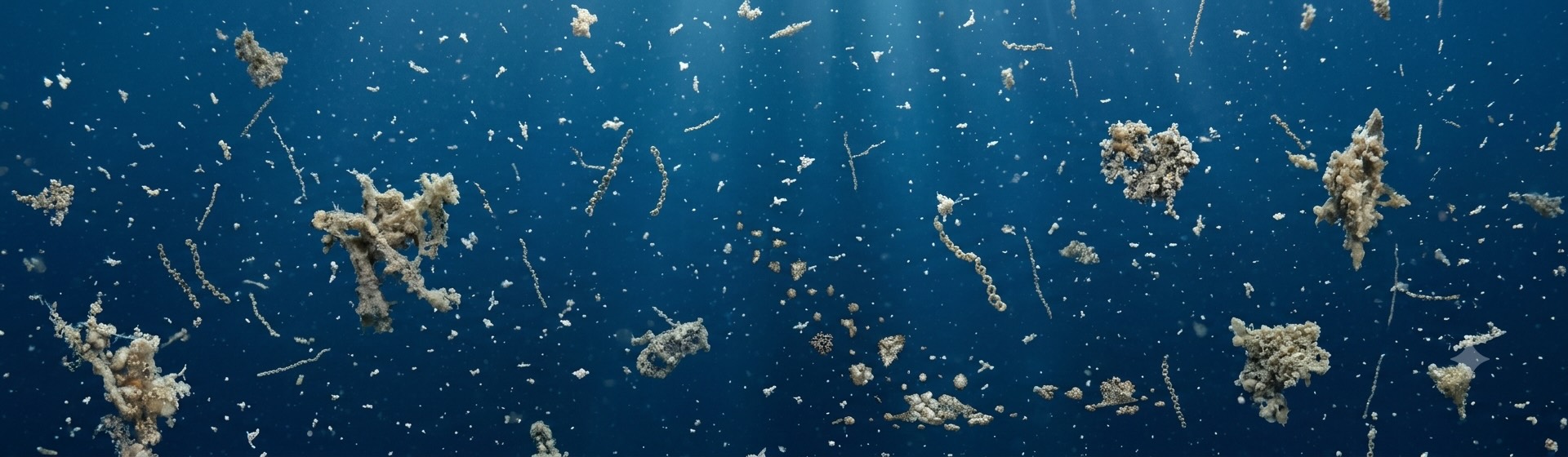
A focused three-day symposium bringing together field oceanographers, laboratory experimentalists, physicists, applied mathematicians, and numerical modellers to develop a closer and genuinely iterative relationship between high-resolution measurements and mechanistic models of marine-snow dynamics.
We invite poster contributions! Notifications of acceptance will be sent on a rolling basis.
Registration fee of 100 EUR includes coffee breaks and on-site lunches. Payment links will be sent to accepted participants.
We will be happy to provide advice, e.g. regarding accommodation.
About the symposium
Field observations of marine snow are advancing rapidly. In situ imaging, autonomous platforms, particle-resolved sampling, and optical and acoustic techniques now provide information at unprecedented spatial, temporal, and size resolution. Nevertheless, it remains difficult to identify the mechanisms responsible for the dynamics observed during individual events, such as phytoplankton blooms.
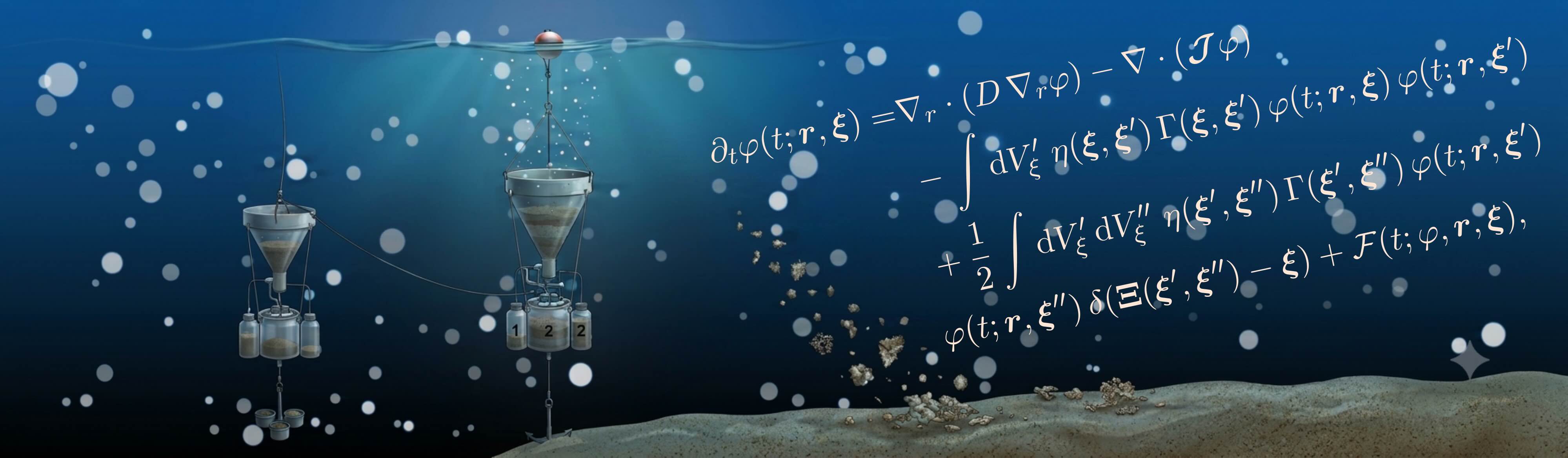
Several processes may act simultaneously, including particle production, aggregation, fragmentation, settling, biological transformation, and remineralization. Mathematical models can help distinguish between these processes, connect measurable quantities to underlying mechanisms, and bridge scales from individual aggregates to evolving particle-size distributions and particulate organic carbon fluxes.
Why now?
Modern observations increasingly resolve the time-dependent evolution of marine-snow populations. However, advanced coagulation-fragmentation models, despite their historically important role in oceanography, are still rarely used to interpret individual high-resolution field data sets. Conversely, measurements are not always designed to discriminate between competing model assumptions or to constrain the quantities that most strongly control model predictions.
The symposium will examine how this gap can be closed: how field measurements can constrain models, and how models can identify informative observables, guide sampling strategies, quantify uncertainty, and reveal which processes can or cannot be inferred from available data.
Aims
The meeting aims to:
- identify the processes controlling marine-snow dynamics in different oceanographic regimes and during individual events;
- improve the inference of hard-to-measure quantities, including particulate organic carbon flux and process rates;
- develop tractable, time-dependent models of evolving marine-snow size spectra;
- determine which measurements best distinguish between competing mechanisms and model closures;
- formulate model-informed observational strategies and shared benchmarks for model-data comparison.
Meeting format
The programme will combine invited scientific talks with focused panel discussions and working sessions. Rather than surveying the field broadly, the meeting will concentrate on a limited number of questions for which close interaction between observations and mathematical models can produce concrete progress.
The symposium is intended to be discussion-driven. Participants will be encouraged to identify specific data sets, model classes, unresolved parameters, and observational limitations that could form the basis of new collaborative projects.
Confirmed speakers
Nathan Briggs National Oceanography Centre, UK
Morten Iversen Alfred Wegener Institute
Magdalena Mrokowska Institute of Geophysics, Pol. Acad. Sci.
Manu Prakash Stanford University
Elisa Romanelli ETH Zürich
Anna Rufas University of Oxford
Lars Stemmann Sorbonne University
Radost Waszkiewicz Potsdam University
Planned outcomes
The principal scientific outcome will be a concise joint review or perspective article identifying the central challenges at the interface between mathematical modelling and field observations. The article will outline priority measurements, modelling developments, and a practical roadmap for integrating high-resolution field data with mechanistic descriptions of marine-snow dynamics.
The meeting is also intended to initiate new collaborations and joint grant proposals centred on mathematical-modelling-informed field measurements.
Practical information
Dates: 2 - 4 December 2026
Venue: Faculty of Physics, University of Warsaw, Pasteura 5, Warsaw, Poland
Format: Invited talks, panel discussions, and focused working sessions
Programme and participation: Further information will be announced.
Organisers
Jonasz Słomka
Emilia Trudnowska (Institute of Oceanology, PAS)
Jan Turczynowicz
Faculty of Physics, University of Warsaw
Contact: Maciej Lisicki
Maciej.Lisicki [at] fuw.edu.pl

Funding: IDUB grant, University of Warsaw